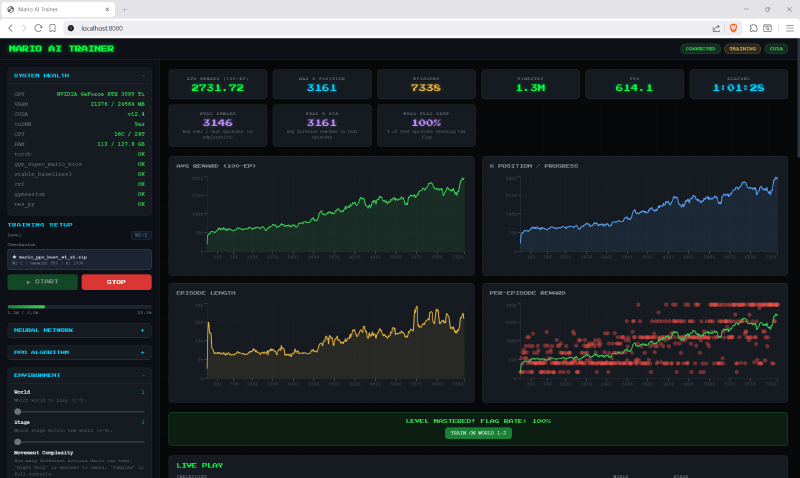
Overview
mario-ai-trainer is a project focused on training a reinforcement learning agent to play Super Mario Bros using modern Python ML tooling. The goal is to make experimentation with game-playing agents accessible on a local machine.
The project combines a classic NES game environment with contemporary RL libraries so you can watch an agent improve over time instead of relying on scripted behavior.
High‑Level Architecture
A typical setup in this space includes:
- A Gym‑compatible Mario environment (via NES emulation)
- A reinforcement learning algorithm such as PPO
- Frame preprocessing (resize, grayscale, stacking)
- Checkpointing and logging for long training runs
- A lightweight server or dashboard for monitoring progress
Getting Started
General workflow:
- Clone the repository\
- Create and activate a Python virtual environment\
- Install dependencies from the project requirements\
- Launch training and monitor logs or any provided dashboard
Refer to the repository README for exact commands and up‑to‑date instructions.
What You Learn by Running It
Training an agent on Mario quickly reveals real‑world RL challenges:
- Sparse vs. dense rewards
- Exploration vs. exploitation tradeoffs
- Long training times for stable performance
- Sensitivity to hyperparameters
Seeing an agent go from random movement to competent play is a practical way to understand these dynamics.
Why This Project
Game environments are a safe, controllable sandbox for AI experimentation. Mario is especially useful because progress is easy to measure and visually interpret.
If you are exploring RL, experimenting with agents, or building intuition for how policies improve over time, mario‑ai‑trainer is a solid hands‑on starting point.
Links
- Repository: https://github.com/mgelsinger/mario-ai-trainer